Wednesday, February 20, 2013

week four: personas & scenarios.

this week, may i introduce four users (and their connections) to walk us through the scenarios i established in my presentation.


how can "mentorship" be used to encourage those who are frightened about the beginning of an LDR?
meet isabel.


isabel is about to graduate from high school. she's headed off to her first-choice school in colorado in the fall, and earlier this semester, she was thrilled… but now she's feeling a little awful and conflicted, because she sort of accidentally fell in love with her boyfriend, chris. whom she once told they could "have a nice time during senior year, but not make a big thing of it," and who is now about to head for school in iowa. she thinks they're too young to be thinking too hard about their future together, but that doesn't stop her from furtively googling "high school sweetheart" statistics in the glow of her laptop. she finds a website that serves to connect people in long distance relationships to help each other get through it, and makes a post about her situation to see if anybody who's been through the same thing has any advice for her. maggie, a junior in college, sees izzie's post and relives a bit of her own fears and doubts from that time. she reaches out and offers to be a mentor to share her experiences and learning with someone who will likely parallel them.


how can the online community help someone navigate a "rough patch" in their LDR?
meet james.


james's girlfriend kelly made a mistake from a few hundred miles away. she confessed and apologized after she went to a frat party with another guy, which in james's mind, was not a big deal, and then danced with him all night, which was kind of a deal, and then also kissed him, which was a pretty big deal. they'd never really talked about how they would handle other people, but they both know they don't feel great about how this went. unenthused about talking to his local friends about it but still hurt, he absently googles to learn about how other people deal with cheating. he comes across a long distance advice and support platform. he reads some related stories, and the multi-faceted replies they received, and decides to post his own to get another take on the situation. a handful of people warn him that one transgression often leads to another, but more people than he expected encouraged him to talk it out with kelly and give it another shot if they both still want to be together, after re-establishing clear guidelines and boundaries that they're both comfortable with.


how can interactive information design help a separated partner connect with others' experiences?
meet lucy.


lucy met her girlfriend anna online. she's an ocean away, but lucy's dad works for an airline, so it's not as bad as it could be. they may only get to spend time in person once every few months, but they find time to talk and skype almost every day, and love making mixtapes and sending letters despite the postage. but the time difference means they each have quite a bit of time when they can't talk to one another, so lucy's taken to using a long distance relationship website to read stories about other couples and share stories of her own. depending on how she's feeling, she can look at funny moments, or embarrassingly sappy cute stuff, or even sad breakups when she wants to feel grateful for what she and anna have. she especially likes the "perfect futures," where people post elaborate fantasies about the lives they wish they were living with their partners, whether they're just in the same place with sweet jobs, or famous movie stars, or on an inter-stellar journey to colonize a new planet.


how can this platform allow for both online and offline friendship and companionship?
meet sarah.


sarah has been with her boyfriend nick for a few years now, and they've gotten through basic training, and a handful of transfers and new locales. the first time they were apart, she cried for days, but she found a website to help her cope better by helping her connect with others who are dealing with similar circumstances. she made online friends with a young army wife who mentored her through those hard first separations, and has developed a healthy rhythm when nick's away, taking care of their dog, and reading books. but things are about to change again: he's being deployed in afghanistan, and he won't be home again for a long time. they spend all the time together they possibly can before he leaves, but sarah knows she's going to need backup to get through this time in her life. she uses the same ldr website that helped her before, but this time she wants to find someone close by. searching through users close to her, she finds mandy, whose boyfriend has been in afghanistan for a few months already. she reaches out to her and the two make a date for lunch a few days after nick leaves, when sarah knows she'll need somebody to talk to about it.


-
lucy's scenario in particular references the sorting of the stream of content by particular topics or feelings, which is something i've been pondering. i like the function in facebook where you begin typing something and if others have already typed the same thing, it becomes a link so that everyone who mentions it connects to the same idea. i also like the idea of hashtags, hyperlinked words or phrases that can trend daily and get everyone interested reading and writing the same kinds of content together all in a flurry... i'm envisioning the story-telling/moment-adding to cleverly read what you're typing, and offer tags and topics that match the words you're already using. here are some of those concepts.


Monday, February 18, 2013

spatial process

for the elements that remain flat from the front, we've just been constructing vector drawings of them to annotate, such as the parking and main entrance signs.


as for the traveling shapes, and the interior signs and directionals, we've been constructing examples of how they work in google sketchup to make sure the forms make dimensional sense, rather than trying to guess and draw them from one angle. again, these are just examples of how these elements will move, rather than molds that they will all mimic. 

an example of a directional hub to tell you which color to follow:


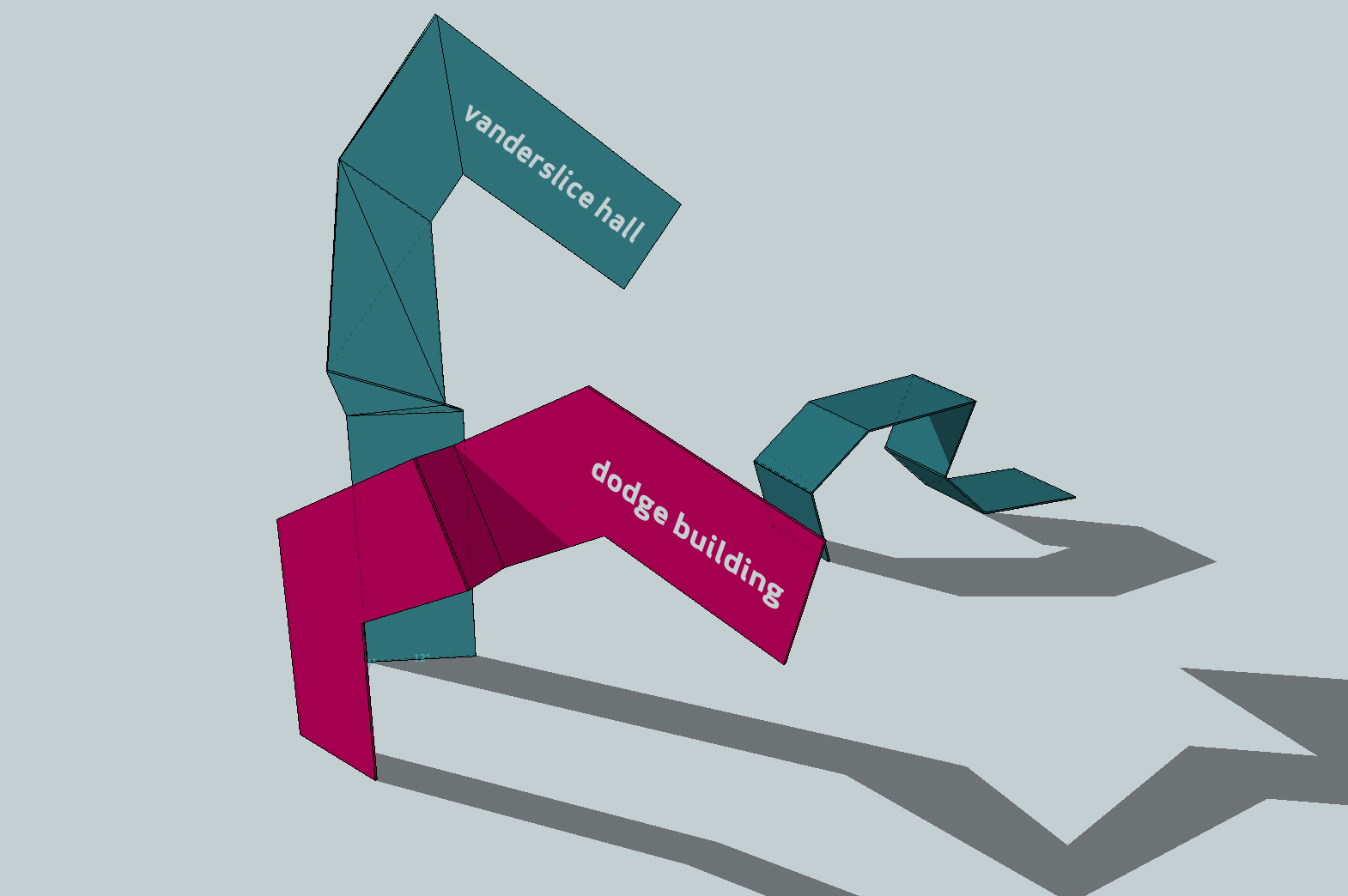
an example of a shape emerging from and re-entering the ground.

a site marker outside a building

an exterior building identifier for vanderslice

an interior wall-mounted directional piece

a bathroom location indicator
a room label


Wednesday, February 13, 2013

week three: presentation & audience stories

this week marked the first official, class-wide presentation of our work so far and our intentions as we move forward. 


i'm spending time at this point doing justice to the surveys i took and cataloguing people's stories. here are some emergent points i've discovered, some more surprising than others. given my sample, which are people that i know directly and through social media and who volunteered to participate in such a survey, the distance is overwhelmingly that of college. even those who have dealt with other types of distance, such as military separation, have also experienced college separation. almost everyone, military excluded, gets to see their partners around once a month. phone, texting, skype, and facebook are huge communication help, while many people also enjoy the intimacy of letters. one coping mechanism that cropped up unexpectedly was that of pets, whether one partner currently has care of the other's, or whether a pet was adopted specifically to help with the separation.

these are some of the people who've shared their stories with me, beginning with a feature narrative.


Sunday, February 10, 2013

spatial experience update


our conceptual focus is still on the metaphor of following your own path, illustrating the diversity of experiences on campus through the different colors that guide you to each building. 


where last we left off, the guide-shapes were undefined in terms of shape and material. we had the sense that they would be somehow three dimensional and hollow… we've refined this idea, and decided that the guide-shapes should instead be constructed from 1/4 inch cold press steel, painted in bright colors, with a consistent width of 12 inches. These long sheets would be folded, bent, and wrapped around the environment and seemingly burrow into surfaces only to reappear further along the route, joining with other colors or splitting off to lead you to your destination, as established at well-labeled moments of crossroads. 


our style guide retains futura medium condensed for the kcai logotype but eliminates the crooked "A" to streamline the text. our main typeface for navigation and description is now apex book, with apex bold emphasis. 


neutral information and space, such as street signs, perimeter, and parking, would contain similar shapes that are painted white so as not to confuse the color-coding of the campus buildings. 


the building identifiers themselves would take the appearance of the "end" of the guide-shape, sticking up out of the ground, with a label cut out.


signage inside a building would be made from the same material and the same color as the guide-shapes outside, folded into smaller individual signs to denote directions, bathrooms, and rooms.

Wednesday, February 6, 2013

week two: asking and mapping

this week i've worked on honing the questions i'm asking and trying to answer. because i tend to work counter-intuitively, i had started with too academic of a questions, full of abstraction and semicolons, and a smattering of similarly lofty subquestions. here's where i've been, and where i'm going.

audit of existing web experiences
the long distance relationship websites in existence tend to be the work of one person or one couple, writing article after article, heavy with the implication that what worked for them will work for everyone. the deficit i find here is the lack of simultaneous, equal voices and personal interconnectivity that a social media platform allows for. 

the mindmapping
i knew i wanted a component of this to be a stream of information or moments, sortable and limitable in a variety of ways. working from the blurry to the specific, i first brainstormed all the different ways to look at the information this system would wrangle.


marty helped me to clear the clouds and focus instead on what specific activities i'm envisioning for a user to be able to complete using this hypothetical platform i'm blueprinting.

what is it i want people to be able to do?


my umbrella question may still be how can social media help provide reassurance and external support to an individual in a long distance relationship?

but here are my new sub-questions, each directly relating to a branch of this map, with the answer to be illustrated in parenthesis:

• how can "mentorship" be used to encourage those who are frightened about the beginning of an LDR? (finding and contacting a mentor)

• how can the online community help someone navigate a "rough patch" in their LDR? (seeking advice on a topic, e.g. cheating)

• how can interactive information design help a separated partner connect with others' experiences? (sorting the overall stream by mood/tag)

• how can this platform allow for both online and offline friendship and companionship?
(finding a live meet-up)

further mindmaps ensued.

by what parameters can users find each other personally? 
what sorts of content can be found and sorted through in the stream?


i'm also presently working on organizing and putting together the surveys i conducted, the designed results of which should be available on this blog soon. 


to-do calendar

anyone who has seen how i work on my computer can attest: my native mechanism is a text document. this one contains a schedule for how i'd like my next few weeks to shake out over this project.


Sunday, February 3, 2013

early spatial experience concept

the kcai website says, "do things your way," and "you travel off the beaten path." for our concept, we tried to work with this idea of finding your way, as well as highlighting the diversity that kcai prizes. 

firstly, here is a location plan of where we determined a need for wayfinding/boundary-setting, with several levels of hierarchy and purpose.


as for the visual concept itself, we're envisioning a system of colorful and angled shapes that guide visitors to their destinations while referencing the outline of the core graphic element. each destination would have its own color designation, and these shapes would emerge from the ground or from architecture along the path to confirm that you're on the right track. an interesting visual complexity will emerge along main through-ways where, like downtown highways, several paths use the same route. in these places, there should be an interplay between the colors, so that it's easy to tell when your path either joins with or separates from others.


moments of crossroads, such as entrances, should clearly elucidate each color and in what direction you should start walking to follow its path. we imagine these navigational guides to be harmonious with the traveling shapes, whether they take the form of the traveling shapes emerging, labeled, from the ground, or if they look more like a signpost with smaller color-coded elements to represent them.

materials we've imagined so far for these elements include clear colored plexiglass, opaque colored plastic, or painted metal.